















ครั้งแรกของประเทศไทย! FWD ประกันชีวิต เปิดตัว “Thailand Longevity Readiness Index”
ครั้งแรกของประเทศไทย! FWD ประกันชีวิต
เปิดตัว “Thailand Longevity Readiness Index”
ดัชนีความพร้อมของคนไทยสู่ยุค Longevity
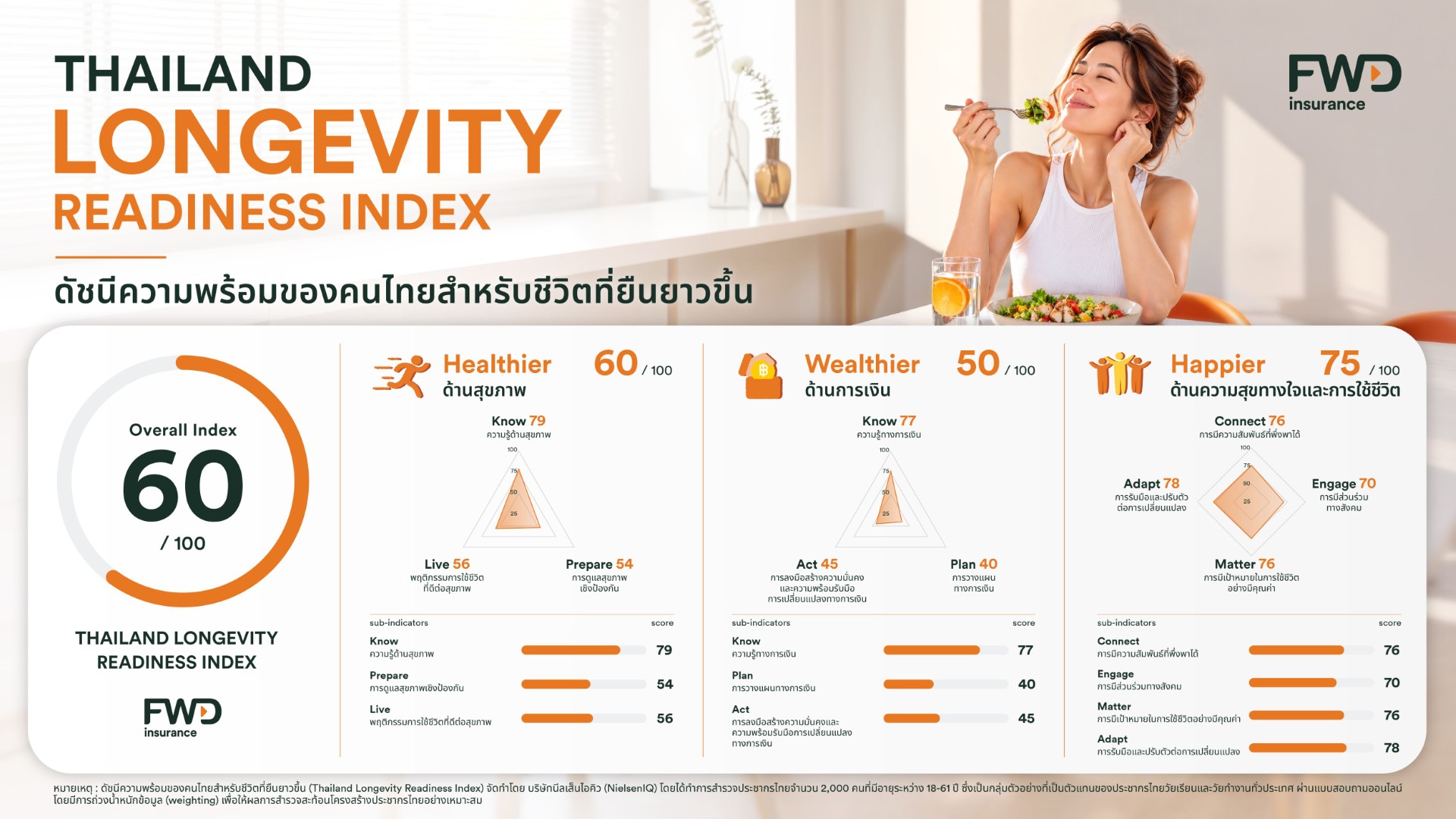
บริษัทเอฟดับบลิวดีประกันชีวิตจำกัด (มหาชน) หรือFWD ประกันชีวิต เปิดตัว “Thailand Longevity Readiness Index” ดัชนีความพร้อมของคนไทยสู่ยุคLongevity เป็นครั้งแรกของประเทศไทย โดยมีNielsenIQ เป็นผู้ดำเนินการศึกษาและร่วมพัฒนากรอบการศึกษาและแนวทางการวิจัยครอบคลุม3 ด้านได้แก่ Healthier ด้านสุขภาพWealthier ด้านการเงินและHappier ด้านความสุขทางใจและการใช้ชีวิต ผ่านการประเมิน10 มิติผลการศึกษาปีแรกพบคะแนนความพร้อมโดยรวม60 จาก100 คะแนนและพบว่าแม้ 79% ของผู้ตอบแบบสำรวจวางแผนชีวิตไว้ถึงอายุ 70 ปีขึ้นไป แต่มีเพียง 31% ที่ประเมินว่าตนเองเตรียมพร้อมสำหรับชีวิตที่ยืนยาวขึ้นในระดับดีถึงดีมากสะท้อนช่องว่างความคาดหวังว่าจะมีอายุยืนยาวกับการเตรียมความพร้อมจริง พร้อมชี้ให้เห็นความสำคัญของการส่งเสริมให้คนไทยเปลี่ยนความรู้ด้านสุขภาพ การเงิน รวมถึงความสุขทางใจและการใช้ชีวิตเป็นการลงมือทำเพื่อรองรับชีวิตที่ยืนยาวขึ้นอย่างมีคุณภาพ
นายณัฐพิสิษฐ์ ครุฑครองชัย ประธานเจ้าหน้าที่บริหาร บริษัท เอฟดับบลิวดี ประกันชีวิต จำกัด (มหาชน)กล่าวว่า “ชีวิตที่ยืนยาวขึ้นไม่ใช่เพียงการมีเวลาเพิ่มขึ้น แต่คือการมีความพร้อมที่จะใช้เวลานั้นได้อย่างมีคุณภาพ ทั้งด้านสุขภาพ การเงิน และความสุขทางใจและการใช้ชีวิต FWD ประกันชีวิต จึงริเริ่ม Thailand Longevity Readiness Index โดยมี บริษัท นีลเส็นไอคิว (NielsenIQ) บริษัทวิจัยผู้บริโภคชั้นนำของโลก เป็นผู้ดำเนินการศึกษาในฐานะผู้เชี่ยวชาญด้านการวิจัย เพื่อทำความเข้าใจว่าคนไทยมีความพร้อมในแต่ละด้านมากน้อยเพียงใด และยังมีเรื่องใดที่ควรให้ความสำคัญ เพื่อส่งเสริมให้การเตรียมพร้อมสำหรับชีวิตที่ยืนยาวในยุค Longevity เป็นเรื่องที่ทุกคนสามารถเริ่มต้นได้ตั้งแต่วันนี้”
Thailand Longevity Readiness Indexศึกษาความพร้อมของคนไทยวัยเรียนและวัยทำงานอายุ 18–61 ปี จำนวน 2,000 คน ผ่านการสำรวจแบบออนไลน์ (Online Panel) ครอบคลุม Gen X, Gen Y และ Gen Z จากทั่วประเทศ ด้วยการถ่วงน้ำหนักให้สอดคล้องกับโครงสร้างประชากรไทยปี 2568 ตามข้อมูลของสำนักงานสถิติแห่งชาติ โดยดัชนีประเมินความพร้อมใน 3 ด้าน ได้แก่ Healthier ด้านสุขภาพ Wealthier ด้านการเงิน และ Happier ด้านความสุขทางใจและการใช้ชีวิต ผ่าน 10 มิติ จากคำถาม 34 ข้อ โดยอ้างอิงกรอบแนวคิด ได้แก่ WHO Healthy Ageing และ ICOPE, OECD/INFE, CFPB ตลอดจนคู่มือการสร้างดัชนีผสมของ OECD/JRC เพื่อประเมินความพร้อมสำหรับชีวิตที่ยืนยาวขึ้นอย่างรอบด้าน
คำตอบแต่ละข้อถูกแปลงเป็นคะแนนในช่วง 0–100 เพื่อประเมินระดับความพร้อมของผู้ตอบแต่ละคนในแต่ละมิติ ก่อนนำมาคำนวณเป็นคะแนนในแต่ละด้านและดัชนีรวม โดยการรวมคะแนนในแต่ละด้านอ้างอิงหลักการค่าเฉลี่ยเรขาคณิต เช่นเดียวกับหลักการที่ใช้ในดัชนีการพัฒนามนุษย์ (HDI) ของ UNDP และปรับใช้ให้เหมาะกับกรอบดัชนีนี้ เนื่องจากเป็นการศึกษาปีแรก จึงยังไม่มีผลจากปีก่อนเป็นฐานเปรียบเทียบ การอ่านผลครั้งนี้จึงเน้นการเปรียบเทียบระหว่างมิติภายใต้กรอบการศึกษาเดียวกัน เพื่อให้เห็นจุดแข็งและด้านที่ควรส่งเสริมเพิ่มเติม
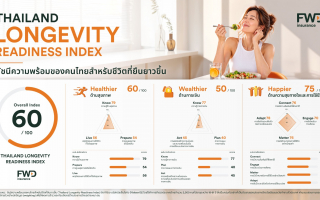
ผลการศึกษาปีแรกพบว่า คะแนนความพร้อมโดยรวมอยู่ที่ 60 จาก 100 คะแนน โดย Happier มีคะแนนสูงที่สุดที่ 75 คะแนน ตามด้วย Healthier 60 คะแนน และ Wealthier 50 คะแนน ชี้ให้เห็นว่ากลุ่มที่ศึกษามีความพร้อมด้านความสุขทางใจและการใช้ชีวิตโดดเด่นกว่าอีกสองด้าน ขณะที่การเงินเป็นด้านที่มีคะแนนต่ำที่สุด จึงเป็นประเด็นสำคัญในการส่งเสริมการเตรียมพร้อมสำหรับชีวิตที่ยืนยาวขึ้น
ด้าน Healthier พบว่าคะแนนความรู้ด้านสุขภาพ (Health Literacy) สูงที่สุดที่ 79 คะแนน ตามด้วยพฤติกรรมการใช้ชีวิตที่ดีต่อสุขภาพ (Healthy Lifestyle) 56 คะแนน และการดูแลสุขภาพเชิงป้องกัน (Preventative Care) 54 คะแนน นอกจากนี้ยังพบว่า ร้อยละ 40 ไม่เคยตรวจสุขภาพหรือรอให้ป่วยก่อนจึงเข้ารับการตรวจ สะท้อนว่าการมีความรู้ด้านสุขภาพเพียงอย่างเดียวอาจยังไม่เพียงพอ หากไม่ได้เปลี่ยนไปสู่การเริ่มลงมือดูแลตนเองอย่างต่อเนื่อง
ด้าน Wealthier พบว่าคะแนนความรู้ทางการเงิน (Financial Literacy) สูงที่สุดที่ 77 คะแนน ตามด้วยการลงมือสร้างความมั่นคงและความพร้อมรับมือการเปลี่ยนแปลงทางการเงิน (Financial Resilience) 45 คะแนน และการวางแผนทางการเงิน (Financial Planning) 40 คะแนน ข้อมูลนี้สะท้อนว่าคนไทยมีความเข้าใจเกี่ยวกับการเงินที่ส่งผลกระทบต่อการมีชีวิตที่ยืนยาวขึ้น แต่ยังไม่ได้เปลี่ยนความรู้นั้นไปสู่แผนเกษียณ การออม และการสร้างหลักประกันรองรับชีวิตที่อาจยืนยาวกว่าที่คาดไว้
ส่วนด้าน Happier พบว่าคะแนนการรับมือและปรับตัวต่อการเปลี่ยนแปลง (Resilience & Adaptability) สูงที่สุดที่ 78 คะแนน ตามด้วยการมีความสัมพันธ์ที่พึ่งพาได้ (Social Support) และการมีเป้าหมายในการใช้ชีวิตอย่างมีคุณค่า (Purpose & Contribution) ที่ 76 คะแนนเท่ากัน และการมีส่วนร่วมทางสังคม (Social Participation) 70 คะแนน แสดงให้เห็นว่าคนไทยวัยเรียนและวัยทำงานมีพื้นฐานด้านความสุขทางใจและการใช้ชีวิตที่ดีสำหรับชีวิตที่ยืนยาวขึ้น อย่างไรก็ตาม คะแนนรวมด้านความสุขที่สูงกว่าด้านการเงินถึง 25 คะแนน สะท้อนว่าคนไทย “ใจพร้อม” รับชีวิตที่ยืนยาว แต่ “เงิน” ยังตามไม่ทัน
“Thailand Longevity Readiness Index มุ่งวัดความพร้อมสำหรับการใช้ชีวิตยุค Longevity อย่างมีคุณภาพโดยไม่ได้มุ่งคาดการณ์อายุขัยหรือเป็นเครื่องมือวัดฐานะทางการเงิน ผลการศึกษาพบว่าคนไทยมีจุดแข็งด้านความสุขทางใจและการใช้ชีวิตส่วนด้านสุขภาพและการเงินการส่งเสริมให้ผู้คนเปลี่ยนความรู้เป็นการลงมือทำยังเป็นเรื่องสำคัญเราหวังว่าข้อมูลนี้จะช่วยให้คนไทยมองเรื่องLongevity เป็นเรื่องใกล้ตัวเห็นความเชื่อมโยงกับการวางแผนชีวิตของตนเองและลงมือทำตั้งแต่วันนี้พร้อมสนับสนุนให้การเตรียมพร้อมสำหรับชีวิตที่ยืนยาวเป็นวาระสำคัญร่วมกันของสังคมเพื่อให้คนไทยใช้ชีวิตได้อย่างเต็มที่และรับมือกับความเปลี่ยนแปลงในระยะยาว”นายณัฐพิสิษฐ์ กล่าวสรุป
ทั้งนี้ การเปิดเผยข้อมูลครั้งนี้เป็นการนำเสนอกรอบการศึกษาและผลภาพรวมระดับประเทศของ Thailand Longevity Readiness Index โดยผลการศึกษาเชิงลึกและรายงานฉบับสมบูรณ์จะเผยแพร่อย่างเป็นทางการบนเว็บไซต์ของ FWD ประกันชีวิต ในเดือนมกราคม 2570 และ FWD ประกันชีวิต จะติดตามผลดัชนีอย่างต่อเนื่องทุกปี เพื่อเป็นเกณฑ์อ้างอิงความพร้อมสู่ชีวิตที่ยืนยาวของคนไทย
A first for Thailand: FWD Life Insurance launches
the ‘Thailand Longevity Readiness Index’
An index of Thais’ readiness for the Longevity era
FWD Life Insurance Public Company Limited (‘FWD Life Insurance’) has launched the Thailand Longevity Readiness Index, the first index of its kind in Thailand to measure how ready Thais are for the Longevity era. NielsenIQ conducted the study and co-developed its framework and research methodology. The index covers three pillars – Healthier (health), Wealthier (finances) and Happier (emotional wellbeing and lifestyle) – assessed across 10 dimensions. The first-year results show an overall readiness score of 60 out of 100. While 79% of respondents have planned their lives up to the age of 70 or beyond, only 31% rate themselves as well or very well prepared for a longer life, revealing a gap between the expectation of living longer and actual preparation. The findings underline the importance of encouraging Thais to turn their knowledge of health, finances, and emotional wellbeing and lifestyle into action, so that they are ready to enjoy a longer life with quality.
Mr Knattapisit Krutkrongchai, Chief Executive Officer of FWD Life Insurance Public Company Limited, said: “A longer life is not simply about having more time; it is about being ready to make the most of that time – in health, in finances, and in emotional wellbeing and lifestyle. That is why FWD Life Insurance initiated the Thailand Longevity Readiness Index, with NielsenIQ conducting the study as our research expert, to understand how ready Thais are in each area and which issues deserve greater attention. Our aim is to make preparing for a longer life in the Longevity era something everyone can start today.”
The Thailand Longevity Readiness Index surveyed 2,000 Thai students and working adults aged 18–61 nationwide through an online panel covering Gen X, Gen Y and Gen Z. Results were weighted to reflect Thailand’s 2025 population structure, based on data from the National Statistical Office. The index assesses readiness across three pillars – Healthier (health), Wealthier (finances) and Happier (emotional wellbeing and lifestyle) – through 10 dimensions and 34 questions. It draws on established frameworks, including the WHO’s Healthy Ageing and ICOPE, OECD/INFE and the CFPB, as well as the OECD/JRC handbook on constructing composite indicators, to provide a holistic assessment of readiness for a longer life.
Each response was converted into a score from 0 to 100 to assess each respondent’s readiness in each dimension, before being aggregated into pillar scores and an overall index score. Pillar scores were combined using a geometric mean – the same principle used in the UNDP’s Human Development Index (HDI) – adapted to suit this framework. As this is the first year of the study, there is no previous-year baseline for comparison. This year’s results therefore focus on comparing dimensions within the same framework to identify strengths and areas for further development.
The first-year results show an overall readiness score of 60 out of 100. Happier scored highest at 75 points, followed by Healthier at 60 and Wealthier at 50. This indicates that respondents’ readiness in emotional wellbeing and lifestyle stands out from the other two pillars, while finances scored lowest. Some 79% of respondents have planned their lives up to the age of 70 or beyond, yet only 31% say they are well or very well prepared, making this a key issue in promoting readiness for a longer life.
In the Healthier pillar, Health Literacy scored highest at 79 points, followed by Healthy Lifestyle at 56 and Preventative Care at 54. The study also found that 40% of respondents have never had a health check-up or wait until they fall ill before getting one. This suggests that health knowledge alone may not be enough unless it translates into consistent self-care.
In the Wealthier pillar, Financial Literacy scored highest at 77 points, followed by Financial Resilience – taking action to build financial security and the ability to cope with financial change – at 45, and Financial Planning at 40. This shows that Thais understand how their finances will be affected by a longer life, but have yet to turn that knowledge into retirement plans, savings and financial safeguards for a life that may last longer than they expect.
In the Happier pillar, Resilience & Adaptability scored highest at 78 points, followed by Social Support and Purpose & Contribution, both at 76, and Social Participation at 70. This shows that Thai students and working adults have a solid foundation of emotional wellbeing and lifestyle for a longer life. However, the 25-point gap between the Happier and Wealthier scores suggests that while Thais’ ‘hearts’ are ready for a longer life, their ‘wallets’ have yet to catch up.
“The Thailand Longevity Readiness Index aims to measure readiness to live well in the Longevity era. It is not designed to predict life expectancy or to measure financial status. The study found that Thais are strong in emotional wellbeing and lifestyle, while in health and finances, helping people turn knowledge into action remains important. We hope these insights will help Thais see longevity as something close to home, recognise its connection to their own life planning and start taking action today. We also want to help make preparing for a longer life a shared priority for society, so that Thais can live life to the full and cope with long-term change,” Mr Knattapisit concluded.
The findings released today present the framework and national-level headline results of the Thailand Longevity Readiness Index. In-depth findings and the full report will be published officially on the FWD Life Insurance website in January 2027. FWD Life Insurance will track the index every year as a benchmark of Thais’ readiness for a longer life.
